
Drilling Intersects 29.53 g/t over 4m at Akoko
Drilling Intersects 29.53 g/t over 4m at Akoko Gold Project in Ghana
Hamak Strategy Limited (LSE: HAMA / OTCQB: HASTF), a Company combining traditional gold exploration in West Africa with a Digital Asset Treasury Management strategy, is pleased to announce that it has received the first batch of assay results, comprising 4 holes of the planned 72 hole 4,125m reverse circulation (“RC”) drill programme at the Akoko oxide gold project in southwest Ghana.
Highlights
· Assays received for the first 4 drill holes at Akoko gold project in southwest Ghana;
· Intersections include 29.53g/t gold over 4m from 7m and 6m at 3.15g/t Au from 64m;
· Results support geological model of wide, near surface gold mineralized horizons;
· RC programme ongoing with a total of 72 holes for 4,125m planned.
CEO and Executive Director Karl Smithson commented:
“Drilling at Akoko has got off to an excellent start with highly encouraging gold intersections returned from the first 4 RC holes received to date. Results include 29.53g/t Au over 4m and 3.15g/t over 6m and more broadly support our geological model of wide and near surface gold mineralized oxide zone which may be amenable to open pit mining.
The 4,125m RC drill programme is progressing well, aided by the soft nature of the upper oxides being targeted and we expect to provide regular updates as the programme progresses and assay results are received.”
RC Drilling
Hamak is undertaking an initial 72 hole, 4,125m RC drilling programme over the Akoko gold project. The programme has been designed to provide confirmatory and infill information to support the conversion of a previously calculated near surface gold mineralization estimate of 252,000 ounces into an industry compliant mineral resource estimate.
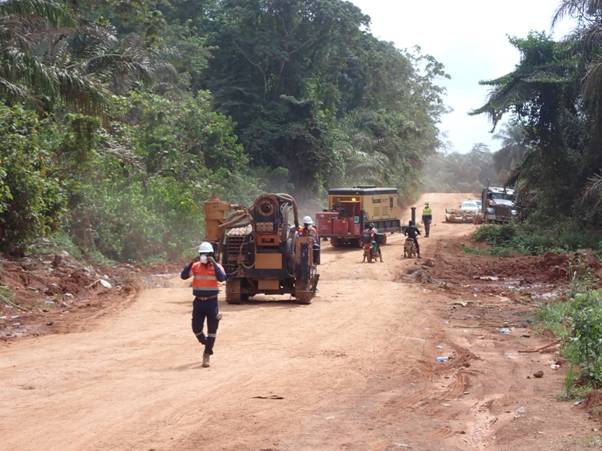
The drill programme has commenced in the north of the Akoko permit where sixteen holes have so far been completed for 1,091 metres. All holes are being drilled at an inclination of 50 degrees to the east and are planned to depths of between 50m and 80m, primarily to test the upper oxide gold mineralization at Akoko. Samples are being collected and logged every metre down hole and are prepared for consignment to the accredited SGS Laboratory Services Ghana Ltd (“SGS”) in nearby Tarkwa.
Drill Results
The first four drill holes, comprising 333 samples, inclusive of quality assurance / quality control (“QA/QC”) samples, were submitted to and processed by, SGS for Au50 fire assay (Table 1). The assay from these holes have returned excellent results which have confirmed the geological model of a near surface, oxide zone with wide intersections of gold mineralization. Significant gold intercepts are show in Table 2 (at a 0.25g/t cut-off).
Table 1: Drill Hole Information (holes with assay results)
| Hole | Easting | Northing | Elevation (metres) | Azimuth (degrees) | Inclination (degrees) | End of Hole (metres) |
| 2026-013 | 596115 | 560100 | 90 | -50 | 80 | |
| 2026-037 | 596050 | 560100 | 90 | -50 | 72 | |
| 2026-038 | 596073 | 560100 | 90 | -50 | 84 | |
| 2026-039 | 596167 | 560049 | 90 | -50 | 70 |
Table 2: Significant Downhole Intercepts
| Hole | From (metres) | To (metres) | Down hole length (metres) | Grade(g/t Au) |
| 2026-013 | 7 | 24 | 17 | 0.79 |
| including | 14 | 24 | 6 | 1.08 |
| 2026-037 | 13 | 17 | 4 | 29.53 |
| Including | 13 | 15 | 2 | 57.29 |
| 64 | 70 | 6 | 3.15 | |
| Including | 66 | 69 | 3 | 6.05 |
| 2026-038 | 6 | 10 | 4 | 0.85 |
| 2026-039 | 23 | 25 | 2 | 0.46 |
Interpretation of Results
Although results are only received from the first four RC drill holes of the planned 72-hole programme, the Company is encouraging to note the high-grade intersections of gold mineralization near surface, particularly from holes 2026-013 and 2026-037.
The interpretation of the oxide and sulphide boundary correlates with that of the historical drilling in the same vicinity. The geological model at Akoko is currently interpreted as a deeply weathered oxide zone down to depths of 80m, which contains broad zones of gold mineralization near to surface.
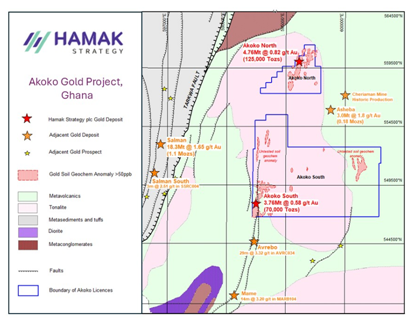
Figure 1: Akoko Gold Project – Historical Gold Estimate and Geochemical Anomalies
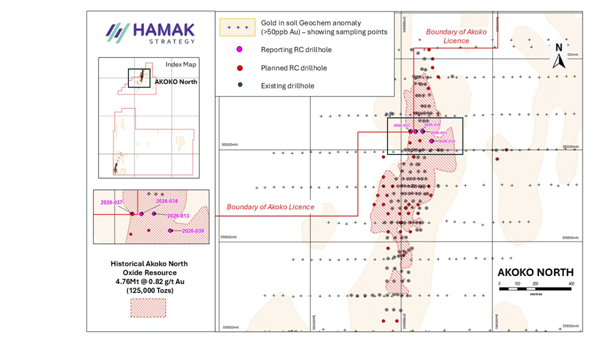
Figure 2: Akoko North – Drill Holes, Historical, Panned and Completed
Analytical and QA/QC
Reverse Circulation drilling samples were collected in large (~800mm x 600mm) plastic retention bags below a cyclone at 1m intervals. Each bag had the relevant metre intervals (eg. 22 – 23m) and hole ID clearly marked on the bag. The total sample recovered from each drilling interval was split, using a three-tier riffle splitter (88%:12%), into a ~2 kg assay sample (collected in a pre-labelled plastic bag) with the remaining bulk (field residue) sample collected in a large plastic bag. The entire bulk sample was put through the riffle splitter. Field Duplicate Samples were also collected. These samples were routinely taken (1 in 20), by re-splitting the total remainder (field residue) over the three-tier riffle splitter (88%:12%) into a ~2 kg assay sample with the remaining bulk sample retained. The splitter was thoroughly cleaned after each metre. All analytical samples were collected in plastic bags (380mm x 250mm) with sample numbers clearly marked on plastic bag using a permanent marking pen. All sample bags were sealed tightly with cable ties to prevent contamination between samples. Samples were transported by Company personnel to the SGS Laboratory at Tarkwa, Ghana.
Sample preparation and analysis by SGS was performed by drying, crushing to -6mm and then pulverizing to <75 microns (-200 mesh) in Cr steel bowls. Analysis for Au was by 50g Fire Assay with an atomic absorption spectrometry (AAS) finish according to the method GE_FAA30V5/FAA50V5 with limits between 5 and 10,000 ppb (10 g/t). Any samples exceeding the upper limit were re-assayed according to method GO_FAA30V10/FAA50V10 with limits between 0.1 and 100 ppm (100 g/t). Laboratory standard reference materials and blanks were submitted randomly within every 50 samples.
In addition to SGS internal QA/QC protocols, Hamak has implemented a quality control programme for all samples collected through the drilling programme. This quality control programme was designed by a qualified and independent third party, with a focus on the quality of analytical results for gold includes the random insertion of blanks (samples known to contain to gold values) and Certified Reference Materials (of precisely known gold content) in each batch of samples submitted to the laboratory. Analytical results were received, imported to our secure on-line database and evaluated to meet our established guidelines to ensure that all sample batches pass industry best practice for analytical quality control.
Qualified Person
The technical information in this announcement that relates to exploration results is based on information reviewed by Hamak Strategy’s retained consultant Dr Colin Andrew, who is an independent Consulting Economic Geologist, and graduate of Imperial College London and the Royal School of Mines and is a Member of the Institute of Materials, Minerals and Mining, a Fellow of the Geological Society of London, a Member of the Society of Economic Geologists, and a registered Chartered Engineer with the Engineering Council. Colin Andrew has over forty years of diverse mining industry experience, relevant to the nature of exploration, the style of mineralization and type of deposit under consideration and to the activity that he is reviewing, to qualify as a an “Independent Qualified Person” as such term is defined in NI 43-101.
For the purposes of UK MAR, the person responsible for arranging release of this announcement on behalf of Hamak is Karl Smithson, CEO and Executive Director.